Quantum key distribution (QKD) is one of the few cryptographic technologies whose security claims rest on physical law rather than computational hardness. While RSA and elliptic-curve cryptography rely on problems being difficult to solve with current or near-future computers, QKD's security guarantee comes from the behavior of quantum particles under measurement. For technical decision makers evaluating post-quantum readiness, understanding how QKD actually works—and what it does and doesn't protect—is essential context alongside post-quantum cryptography (PQC) algorithms.
This article breaks down the core mechanism, why eavesdropping is detectable, the main protocol families, and where QKD stands in real-world deployment as of 2025–2026.
The Basic Mechanism
At its core, QKD works by encoding information onto individual quantum particles—typically photons—and sending them between two parties over a quantum channel. Each photon carries a single bit of data expressed as a quantum state, such as polarization or phase.
NIST describes its own QKD system in concrete terms: it uses single photons, the smallest particles of light, in different orientations to produce a continuous binary code, or "key," for encrypting information. In the classic setup, the two communicating parties are conventionally named Alice (sender) and Bob (receiver).
A typical implementation, often called the BB84 protocol, works like this:
- Alice's system uses lasers to generate individual pulses of light called photons.
- Each photon is sent in one of two modes: either vertical/horizontal, or plus 45 degrees/minus 45 degrees.
- Within each mode, one orientation represents the digital value 0, and the other represents the digital value 1.
- Alice randomly chooses both a mode and a value for each photon sent over the quantum channel.
- Bob randomly chooses between the two modes when trying to detect each incoming photon.
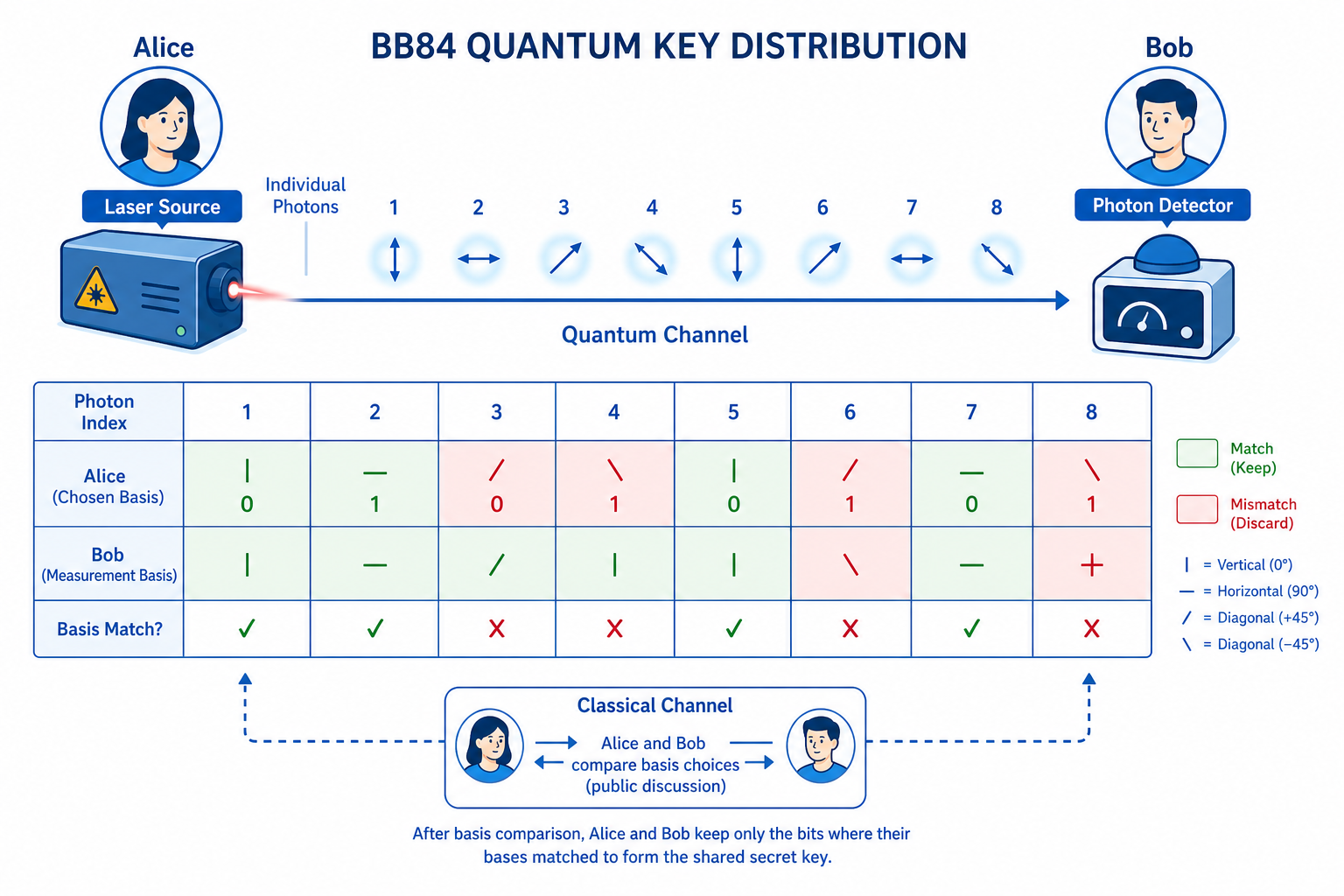
Because Bob doesn't know in advance which mode Alice used for each photon, he'll guess correctly only part of the time. After the transmission is complete, Alice and Bob communicate over a separate, ordinary (classical) channel to compare which modes they used—without revealing the actual bit values. Two parties use a quantum channel to transmit photons and a classical channel to verify results. The quantum channel carries the raw key material while the classical channel handles coordination and authentication—both are essential, since the quantum exchange ensures security through physics while the classical exchange makes sure both sides are talking to each other.
They discard the bits where their mode choices didn't match and keep only the bits where they used the same mode. This surviving set of bits becomes the raw material for the shared secret key.
Why Eavesdropping Is Detectable
The defining property of QKD—and the reason it generates so much interest among security architects—is that any attempt to intercept the key exchange leaves a detectable trace. This isn't a matter of clever engineering; it follows from a fundamental principle of quantum mechanics: measuring a quantum system generally disturbs it.
As one technical review frames it, if an eavesdropper attempts to learn information about signals sent through a quantum channel, she will have to perform some sort of measurement on the signals, and a measurement will generally disturb the state of those signals. Alice and Bob can catch an eavesdropper by searching for traces of this disturbance—the absence of disturbance assures them that Eve almost surely does not have any information about the transmitted signals.
NIST explains the practical mechanics of this. If someone (conventionally called "Eve") tries to eavesdrop on the transmission, she will not be able to "read" it without altering it, since she must randomly position her receiver to intercept the transmission. The photon is converted to electrical energy as it is measured and destroyed, so Eve must generate a new quantum message to send to Bob, but she must guess the correct settings—and guessing wrong introduces detectable errors.
In practice, the keys are generated by transmitting single photons polarized in one of four possible ways. An eavesdropper reading the transmission causes detectable changes at the receiver, and when such changes are observed, the associated key is not used for encryption.
This detection process is built directly into the classical post-processing step. After the sender and receiver only use the bits that were measured the same way, they compare a sample of those bits over the classical channel. Slight discrepancies may be attributed to normal channel errors, but major discrepancies indicate interference by an eavesdropper. If eavesdropping is not detected, some classical processing refines the key, and then it's ready for use.
This is a meaningfully different security model than classical cryptography. Rather than making interception computationally infeasible, QKD makes undetected interception physically impossible under the assumptions of quantum mechanics. If Eve is present, Alice and Bob will know—and they simply discard the compromised key material rather than using it.
Protocol Types: Prepare-and-Measure vs. Entanglement-Based
The BB84-style approach described above is called a "prepare-and-measure" protocol, and it's not the only possible QKD protocol—there are also entanglement-based protocols that use quantum teleportation to transmit keys with even stronger security.
In prepare-and-measure schemes like BB84, Alice actively prepares each photon in a specific quantum state and sends it to Bob. Entanglement-based protocols instead rely on pairs of entangled photons, where measuring one photon's state instantaneously correlates with the state of its entangled partner, regardless of distance. Both approaches ultimately deliver the same functional outcome—a shared, secret bit sequence with built-in eavesdropping detection—but they differ in their underlying quantum resources and, in some analyses, in the strength and nature of their security proofs.
For technical architects, the choice between protocol families is generally an implementation detail handled by hardware vendors rather than something end users configure directly. What matters more for planning purposes is understanding the deployment model (fiber-based terrestrial links, trusted-relay networks, or satellite-assisted) since this drives cost, distance, and integration considerations.
What QKD Actually Protects (and What It Doesn't)
A common misconception is that QKD encrypts data end-to-end. It does not. QKD does not protect messages—it protects the keys that protect the messages—and it is compatible with existing encryption algorithms.
More precisely: quantum key distribution is only used to reduce and distribute a key, not to transmit any message data. That key can then be used with any chosen encryption algorithm to encrypt and decrypt a message sent over a standard channel, with the one-time pad most commonly associated with QKD as it is provably secure when used with a secret, random key.
This distinction matters for architecture planning. QKD systems typically sit alongside—not instead of—existing encryption infrastructure. A QKD link generates and distributes symmetric key material; that key material is then fed into a conventional symmetric cipher (or, in the theoretically strongest case, a one-time pad) to actually encrypt application data. This means QKD deployment doesn't replace your TLS stack, VPN concentrators, or application-layer encryption—it changes how the underlying symmetric keys are generated and exchanged between two fixed endpoints.
Real-World Speeds and Distances
Laboratory and field results show both the promise and the current physical constraints of QKD.
On the performance side, a NIST system produced a "raw" key at a rate of more than 4 million bits per second over 1 kilometer of optical fiber, also working (more slowly) over 4 km, with an error rate of only 3.6 percent, considered very low. These figures illustrate that QKD can generate substantial key material quickly over short distances, though raw key rates are reduced after the classical post-processing and error-reconciliation steps that produce the final usable key.
Distance, however, remains QKD's fundamental limitation. Fiber-based QKD works by sending photons across optical links, and today these links are based on optical fibers, with a corresponding distance limitation caused by loss. As photons travel through fiber, some are inevitably absorbed or scattered, and signal loss increases with distance.
This is where QKD runs into a constraint that doesn't affect classical networking: in a classical system, signal loss can be overcome by copying and amplifying information, but the no-cloning theorem forbids that in a quantum system. The no-cloning theorem is a foundational result in quantum mechanics stating that an unknown quantum state cannot be copied exactly—which is precisely what makes QKD secure against eavesdropping, but also what prevents simple signal amplification over long distances.
Instead, scientists are developing quantum repeaters, which distribute and swap entanglement among photons in a network, generating long-distance entanglement from many short-distance links. Quantum repeaters remain an active area of research rather than a mature, widely deployed commercial technology.
The Satellite Approach: Micius
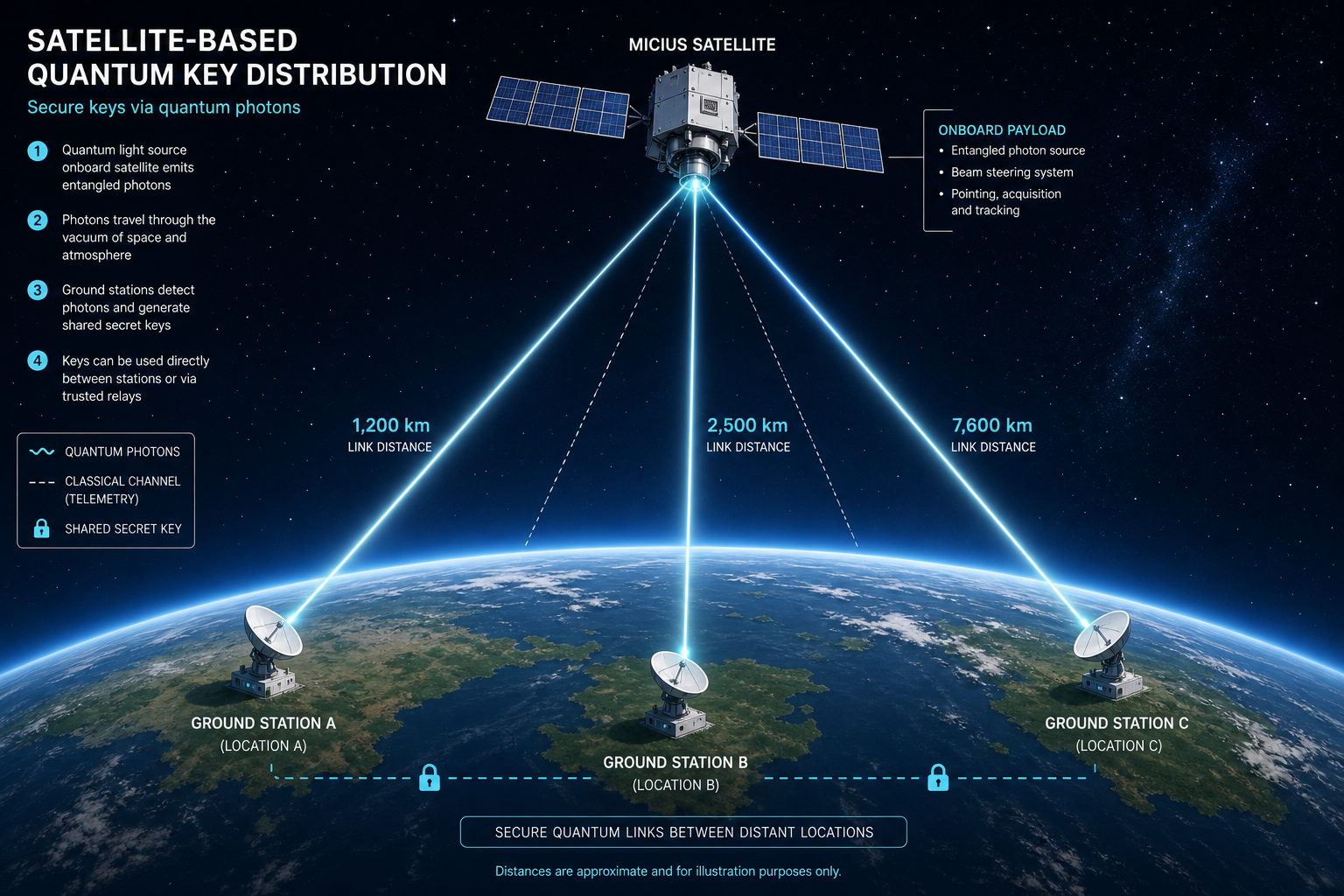
To sidestep fiber-loss limitations, researchers have turned to free-space and satellite links, where photons travel through the vacuum of space rather than lossy fiber over long stretches. China's Micius satellite is the most cited long-distance milestone in this area. Since China's Micius satellite demonstrated quantum key distribution over 7,800 km in 2016, governments and commercial players have intensified development efforts.
Technically, the Micius satellite, launched in 2016, performed downlink QKD with polarization encoding from the satellite to the ground, at 1 kbps over distances up to 1200 km. Bit rates at these distances are far lower than fiber-based short-range systems, reflecting the tradeoff between distance and throughput inherent in free-space optical links.
Micius has also been used in a trusted-relay configuration: it was used as a trusted relay to distribute secure keys between ground stations at Xinglong, Nanshan, and Graz (Austria), with distances of 2,500 km and 7,600 km respectively. In a trusted-relay model, the satellite (or an intermediate node) establishes separate keys with each ground station and then securely relays key material between them—meaning the relay node itself must be trusted not to be compromised, a security assumption distinct from the end-to-end guarantees of direct QKD links.
Current State of Deployment (2025–2026)
Commercial and National Networks
QKD has moved beyond pure research into commercial and government-backed deployment, though it remains a niche technology relative to conventional cryptography. Vendors including ID Quantique, Toshiba, and Quantum Xchange offer commercial QKD systems.
These systems typically operate over optical fiber, with distances up to tens of kilometers (or more with trusted repeaters). The market opportunity is drawing increasing investment: the global quantum communications market—valued around $1.1 billion in 2023—is projected to grow to $8.6 billion by 2032.
Toshiba has been particularly active in real-world pilot deployments. This includes work with US bank Wells Fargo and other partners to test a fully operational QKD deployment demonstrating how different products and technologies can work together, as well as deployment of Hungary's first multi-node Quantum Key Distribution Network as a blueprint for the EuroQCI initiative (the European Quantum Communication Infrastructure).
Financial services and government sectors are natural early adopters given their long-term data confidentiality requirements and exposure to "harvest now, decrypt later" threats, where encrypted data intercepted today could be decrypted once sufficiently powerful quantum computers exist.
National and Regional Networks
Terrestrial QKD is expanding with national networks now operating in China, South Korea, Switzerland, and parts of Europe. These networks generally connect a limited number of fixed points—data centers, government facilities, or financial institutions—rather than functioning as general-purpose internet infrastructure.
Space-Based Expansion
China remains the undisputed leader in space-based QKD, with its Micius and Jinan-1 satellites having demonstrated multi-thousand-kilometer QKD links, intercontinental entanglement distribution, and the world's most advanced satellite-based quantum communication tests. China's roadmap points toward a multi-satellite quantum internet by 2030.
Europe is working to close this gap, with EAGLE-1, led by SES, expected to conduct Europe's first end-to-end QKD trials in 2026. This reflects a broader pattern of national and regional investment in sovereign quantum communication capability, driven partly by strategic and security considerations around long-term data protection.
Practical Considerations for Technical Decision Makers
For architects and decision makers evaluating QKD, several practical realities are worth keeping in mind:
QKD requires dedicated physical infrastructure. Unlike software-based post-quantum cryptography, QKD depends on specialized hardware (single-photon sources and detectors) and either dedicated fiber links or line-of-sight free-space/satellite connections. This makes it fundamentally different from a drop-in software upgrade.
Distance and point-to-point topology are real constraints. Current commercial fiber-based systems operate over tens of kilometers without repeaters, and trusted-relay architectures introduce their own trust assumptions at intermediate nodes. QKD is best suited to specific high-value, fixed-endpoint links rather than as a general replacement for internet-scale key exchange.
QKD complements, rather than replaces, your existing cryptographic stack. Because it only distributes symmetric key material, it needs to be paired with a conventional cipher to actually protect data in transit. Organizations evaluating quantum-resistant strategies are also weighing purely software-based post-quantum cryptographic algorithms, which don't require new physical infrastructure and can be deployed more broadly, alongside or instead of QKD.
Deployment maturity varies significantly by sector and geography. Financial services, government, and telecom operators in China, parts of Europe, South Korea, and Switzerland are furthest along in production or near-production pilots. For most organizations, QKD remains an emerging capability worth monitoring rather than an immediate deployment priority—though the underlying physics and detection guarantees make it a technology worth understanding as quantum-safe security strategies mature.
QKD vs. Post-Quantum Cryptography (PQC): Quick Comparison
| Aspect | QKD | Post-Quantum Cryptography (PQC) |
|---|---|---|
| Security basis | Laws of physics (quantum measurement disturbance) | Computational hardness of mathematical problems |
| Infrastructure required | Dedicated hardware (photon sources/detectors), fiber or free-space/satellite links | Software-based; runs on existing classical networks |
| What it protects | Only the key material, not the message itself | Can protect keys and, depending on algorithm, other data |
| Distance limitations | Tens of km over fiber without repeaters; longer via trusted relays or satellites | None inherent to the algorithm itself |
| Deployment model | Point-to-point, fixed-endpoint links | Broadly deployable, drop-in software upgrade |
| Maturity (2025–2026) | Niche commercial/government pilots | Standardized (e.g., NIST PQC algorithms), broader rollout underway |
| Eavesdropping detection | Built-in, physically guaranteed | Not applicable (relies on computational infeasibility) |